
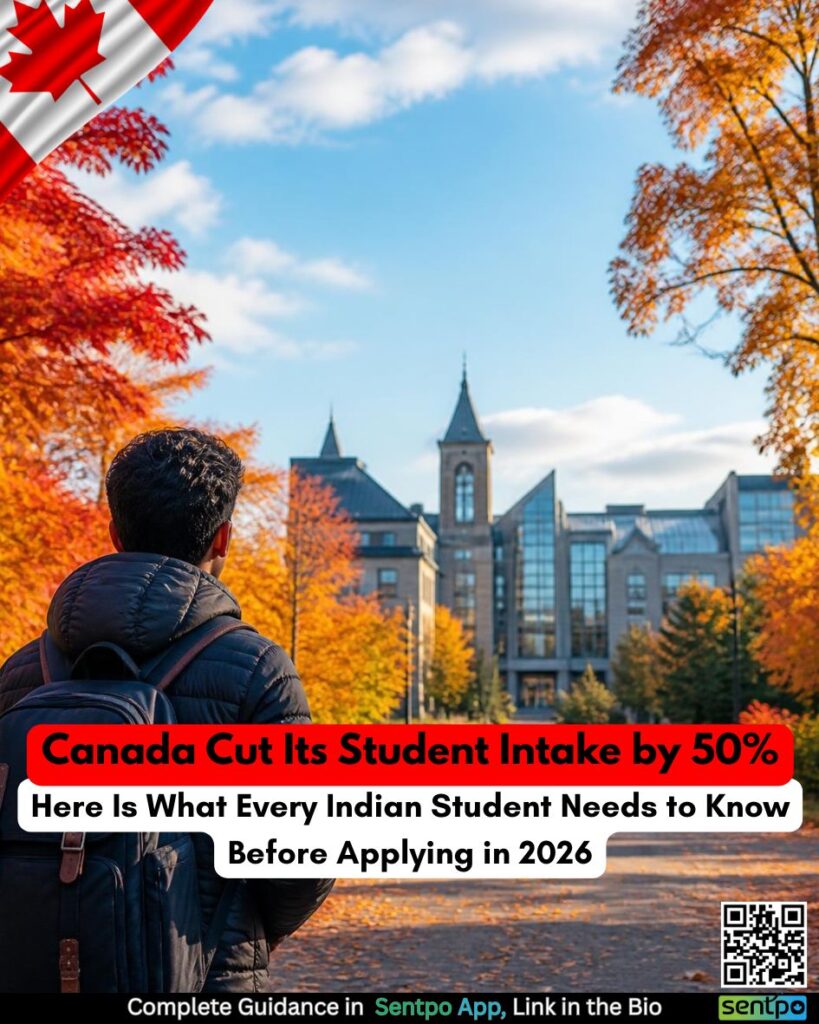
Canada Study Permit 2026 — What Changed and What Indian Students Need to Know
Canada · Study Permit · 2026
Canada Study Permit 2026 — What Changed and What Every Indian Student Needs to Know
Canada has fundamentally changed its international student programme over the past two years. The intake cap has been slashed, the approval rate for Indian students fell to historic lows, new financial requirements have been introduced, and the post-graduation work permit rules have been tightened significantly. This article gives you the complete, verified picture of what Canada’s study permit system looks like in 2026 — and what it means for Indian students considering Canada as a destination.
📌 Key 2026 numbers: Total study permits capped at 408,000 — down from 437,000 in 2025 and 485,000 in 2024. New arrivals limited to 155,000. Master’s and PhD students at public universities are exempt from PAL for the first time. Financial proof requirement: CAD $22,895 in living funds plus first-year tuition.
✈️ Exploring your study abroad options? Sentpo connects Indian students with verified education consultants who can guide you through Canada, Germany, UK, and more. Download the Sentpo app — link in bio.
The Study Permit Cap — What the Numbers Actually Mean
Canada introduced a national cap on international student study permits in 2024 and has reduced it every year since. Here is the confirmed trajectory from official government sources:
| Year | Total Permits Target | New Arrivals Only |
|---|---|---|
| 2024 | 485,000 | — |
| 2025 | 437,000 | — |
| 2026 | 408,000 | 155,000 new arrivals |
Of the 408,000 total permits expected in 2026, only 155,000 are for newly arriving international students. The remaining 253,000 are extensions for students already in Canada. This is a dramatic reduction — new arrivals in 2026 are down nearly 50% from 2024 levels.
A total of 309,670 study permit application spaces are available under the cap for PAL/TAL-required students for the 2026 calendar year. This is the actual pool that most undergraduate and diploma applicants are competing for.
📌 Why the reduction? Canada’s government states it is working to reduce the overall temporary population and bring sustainability back to the immigration system — addressing pressures on housing, healthcare, and public services.
What This Means for Indian Students Specifically
India has historically been Canada’s single largest source of international students. But the numbers for Indian applicants have deteriorated sharply over the past two years — and the 2026 picture is still significantly more difficult than it was in 2022 or 2023.
📊 Study permit approval rate: Dropped from 57.9% in 2021 to 44.9% in 2024, then fell to 35.7% in 2025. Study permit refusal rates climbed to 65.4% by mid-2025, up from 40.5% in 2023.
📊 Indian rejection rate: In August 2025, Canada rejected 74% of Indian study permit applications — up from 32% in August 2023. The number of Indian applicants in that month fell from 19,175 to 3,920.
📊 2026 outlook: There is some reason to expect modest improvement in 2026 as IRCC’s allocation model accounts for refusal rates and expects approval rates to trend back toward historical norms above 50% — but this is not a guarantee for individual applicants.
⚠️ Honest assessment: Indian families considering Canada are now making a more transactional decision than an aspirational one — weighing upfront funds, approval odds, spousal options, post-study work rights, and the chance that the student-to-work-to-PR sequence will succeed at every stage. Canada remains viable for applicants with strong academic profiles, graduate-level plans, and well-documented finances.
The Provincial Attestation Letter (PAL) — The Biggest Change for 2026
Since January 2024, most study permit applicants must include a Provincial Attestation Letter (PAL) or Territorial Attestation Letter (TAL) with their application. This letter — issued by the province through your university — confirms that your application counts toward that province’s share of the national cap.
The most important 2026 update: From January 2026, Master’s and doctoral students at public Canadian universities no longer need a Provincial Attestation Letter and are exempt from the national cap entirely. This is a significant positive change for graduate applicants.
Who Needs a PAL in 2026
❌ Undergraduate students (Bachelor’s degree) at colleges and universities
❌ Diploma and certificate students at colleges
❌ Post-graduate diploma and certificate students at colleges
Who is Exempt from PAL in 2026 (New)
✅ Master’s students at public universities — fully exempt from PAL and cap (new for 2026)
✅ PhD students at public universities — fully exempt from PAL and cap (new for 2026)
✅ Students applying to renew or extend an existing study permit
✅ Quebec students (who require a Quebec Acceptance Certificate — CAQ — instead)
⚠️ Important: You do not apply for the PAL yourself. Your Designated Learning Institution (DLI) applies to the province on your behalf once you have received your acceptance letter. Applying without a required PAL/TAL leads to an application being returned as incomplete.
Financial Requirements — What You Need to Show
Canada has introduced stricter financial checks for international students. While the minimum proof of funds requirement amount is set, immigration officers now closely examine where the money comes from and whether applicants have genuine and sufficient funds to complete their studies.
| Requirement | Amount (2026) |
|---|---|
| Living funds (single applicant outside Quebec) | CAD $22,895 |
| First-year tuition fees | Full amount (varies by programme) |
| Return airfare | Proof required |
| Acceptable proof forms | Bank statements (4 months), GIC, education loan sanction letter |
⚠️ New financial scrutiny in 2026: Immigration officers will now carry out a more detailed review of applicants’ finances to ensure they have genuine and sufficient funds. They will examine the source of funds — not just the amount. Funds that appear suddenly in a bank account without a clear documented source are a common rejection reason. Prepare a clear explanation letter for any large deposits.
Also note: The Student Direct Stream (SDS) has been permanently closed. Indian students previously benefited from faster processing under the SDS by submitting a Guaranteed Investment Certificate. That faster pathway no longer exists — all Indian applicants must now use the regular study permit process.
Post-Graduation Work Permit (PGWP) — The Rules Have Changed
The PGWP is the most important document in every Indian student’s Canadian immigration journey. Without it, there is no way to work legally in Canada after graduation, no Canadian work experience for Express Entry, and no route to permanent residence. The PGWP rules changed significantly in November 2024 and have been confirmed for 2026. Here is exactly what applies:
Language Requirement (New — from November 2024)
Language proof is now mandatory for all PGWP applicants. Degree graduates (Bachelor’s, Master’s, PhD) must show CLB 7 — approximately IELTS 6.0 in each band. College diploma graduates must show CLB 5. This applies to applications submitted on or after 1 November 2024.
Field of Study Requirement
Bachelor’s, Master’s, and doctoral graduates are exempt from the field-of-study rule. College and non-degree graduates generally must have studied in an eligible field linked to long-term labour shortage occupations if they applied for their study permit on or after 1 November 2024. Priority fields include Healthcare, STEM, Trades, Agriculture, and Social Services. IRCC confirmed in January 2026 that the PGWP-eligible field-of-study list is frozen for the rest of 2026 — no fields will be added or removed.
Public-Private Partnership Programmes
Graduates of public-private partnership programmes lost PGWP eligibility entirely under the November 2024 changes, regardless of field of study or grades. Always verify that your institution is a fully public Designated Learning Institution before applying.
PGWP Duration
PGWP length is tied to programme length, ranging from approximately 8 months to 3 years. Master’s and PhD graduates from 16-plus month programmes at public universities typically qualify for the full 3-year permit. This is unchanged in 2026 and continues to be a major advantage for Master’s students.
💡 Bottom line for Indian students: The casual approach — picking any programme, graduating, then figuring out PGWP and PR — is no longer viable. The PGWP rules now reward students who choose degree programmes (especially Master’s and doctoral) in high-demand fields, achieve strong language scores, and plan their entire immigration pathway from Day 1.
Which Provinces Are Most Accessible for Indian Students in 2026?
Each province receives a fixed allocation of study permit spaces under the national cap. Some provinces are significantly more accessible than others — particularly Atlantic Canada, which has actively been positioning itself to attract international students.
Ontario
The largest province by allocation with 70,074 expected spaces for PAL-required applicants. Home to University of Toronto, McMaster, Western, and many top institutions. Most competitive — apply early.
British Columbia
Home to UBC and SFU. High demand and competitive allocation. Strong tech job market. Preferred by many Indian students but slots fill quickly.
Atlantic Canada — Nova Scotia, New Brunswick, PEI, Newfoundland
Applying to Atlantic Canada institutions improves your chances under the current system. Lower competition for PAL spaces, institutions are actively recruiting international students, and the Atlantic Immigration Program offers a direct pathway to PR after graduation with a job offer.
Quebec
Uses a separate Quebec Acceptance Certificate (CAQ) system rather than PAL. Lower competition from Indian students due to French language requirements, but English-medium programmes exist at McGill and Concordia. CAQ processing can add 4 to 8 weeks to your timeline.
The Pathway from Study Permit to PR — Does It Still Work?
The reason most Indian students chose Canada over other destinations was always the PR pathway — study, get PGWP, work, apply for Express Entry. That pathway still exists in 2026, but it is narrower and requires more strategic planning than it did before.
Step 1: Study permit → Study at a public DLI (Master’s recommended for PAL exemption and 3-year PGWP)
Step 2: PGWP → Apply within 180 days of final grades, with CLB 7 language proof. Work anywhere in Canada.
Step 3: Work experience → Accumulate minimum 1 year of skilled Canadian work experience (NOC TEER 0, 1, 2, or 3)
Step 4: Express Entry → Apply under Canadian Experience Class. With a Canadian Master’s + 1 year work experience + strong IELTS, you should score 470–510+ CRS — typically sufficient for an invitation to apply.
Alternative: Provincial Nominee Programme (PNP) → A provincial nomination adds 600 CRS points to your Express Entry profile — virtually guaranteeing an invitation to apply for PR.
⚠️ Reality check: Not every credential and not every PGWP leads cleanly to PR in 2026. Programme choice matters enormously. A student who picks a diploma programme at a private-public partnership institution may find themselves unable to get a PGWP after graduation — and therefore unable to accumulate the Canadian work experience needed for Express Entry.
Canada Study Permit 2026 — Complete Quick Reference
| Detail | Information |
|---|---|
| Total permits 2026 | 408,000 (down from 437,000 in 2025) |
| New arrivals only | 155,000 |
| PAL/TAL required for | Undergraduates, diploma, certificate students |
| PAL/TAL exempt (new 2026) | Master’s and PhD at public universities |
| Financial proof (living funds) | CAD $22,895 + tuition + return airfare |
| Student Direct Stream (SDS) | Permanently closed — no longer available |
| Indian refusal rate (Aug 2025) | 74% (up from 32% in August 2023) |
| PGWP language — degree grads | CLB 7 (IELTS 6.0 per band) |
| PGWP — Master’s graduates | 3 years (for 16+ month programmes) |
| Field of study restriction | Degree grads exempt — college grads must check list |
| Best strategy for Indian students | Master’s at public university — PAL exempt, 3-yr PGWP, field exempt |
Is Canada Still Worth It for Indian Students in 2026?
The honest answer is: it depends on what you are going for and how you plan.
Canada makes sense if:
✅ You are applying for a Master’s or PhD at a public university — PAL exempt, 3-year PGWP, no field restrictions
✅ You have well-documented finances with a clear, verifiable source of funds
✅ You have a strong IELTS score — 6.5 overall with no band below 6.0 at minimum
✅ You have a strong academic profile with a clear, genuine reason for choosing Canada and your specific programme
Canada may not be the right choice if:
❌ You are applying for a college diploma programme at a private or private-public partnership institution — high refusal risk and PGWP uncertainty
❌ Your primary goal is cost saving — Canadian tuition for international students remains CAD $25,000–$45,000 per year at most universities
❌ You are looking for zero or near-zero tuition — Germany’s public universities offer this for international students at every level
What Should You Do Right Now?
01 | Target a Master’s or PhD at a public university. This is the single most important strategic decision. It exempts you from the PAL, the cap, and the PGWP field-of-study restriction — and gives you a 3-year PGWP for PR. |
02 | Prepare clean, well-documented financials. Show CAD $22,895 in living funds plus full first-year tuition. Money must have a clear, documented source — savings, salary, parental support with proof. Unexplained deposits are a leading rejection reason. |
03 | Score IELTS 6.5+ now. You need it for the study permit, and you will need CLB 7 again for the PGWP. Get it done early. A strong IELTS score also strengthens your study permit application. |
04 | Apply early and write a strong study plan. Immigration officers look for genuine student intent. Your study plan must explain clearly why you chose Canada, why this university and programme, and what your career plans are after graduation. |
05 | Compare your options. Germany offers zero tuition at public universities, a clear post-study work visa, and the EU Blue Card PR pathway. If your goal is a Master’s in engineering, AI, data science, or business — Germany may offer a stronger value proposition in 2026 than Canada. |
✈️ Not Sure Which Country is Right for You?
Compare Canada, Germany, UK and more on Sentpo — with a verified consultant guiding you.
Browse verified programmes across multiple countries, understand the real costs and pathways, and connect with a consultant who knows the 2026 rules inside out. Fully digital. No office visits.
→ Download the Sentpo AppSources — All verified August 2026
▪ Government of Canada (IRCC) — 2026 Provincial and Territorial Allocations Under the International Student Cap
▪ Government of Canada (IRCC) — PAL/TAL Policy Updates — February 2026
▪ Scholaro — Canada’s International Student Cap 2026 — What It Means for Applicants
▪ VisaVerge — Canada Study Visa Changes 2026 — Impact on Indian Students
▪ Goodwind — Canada Student Visa 2026 — What Indian Students Need to Know
▪ EEC Global — PGWP Canada 2026 — New Rules and Eligibility
▪ Ardent Overseas — Post Study Work Visa in Canada for Indian Students 2026
Related Posts
Data Science, Data Analytics & Data Engineering: Courses, Eligibility and Career Opportunities
Discover what these fields mean, which courses you can study after Class 12 or graduation, and how to explore career…
DAAD EPOS Scholarship 2027: Master’s in Germany, Eligibility & Deadline
Study Abroad · Germany · Scholarships DAAD EPOS Scholarship 2027: Study in Germany with Financial Support Explore a two-year master’s…