Siemens €3 Billion Deal — Jobs in Germany for Indian Students (2026
Siemens Wins a €3 Billion Train Deal — What It Means for Jobs in Germany and Indian Students Planning Their Career
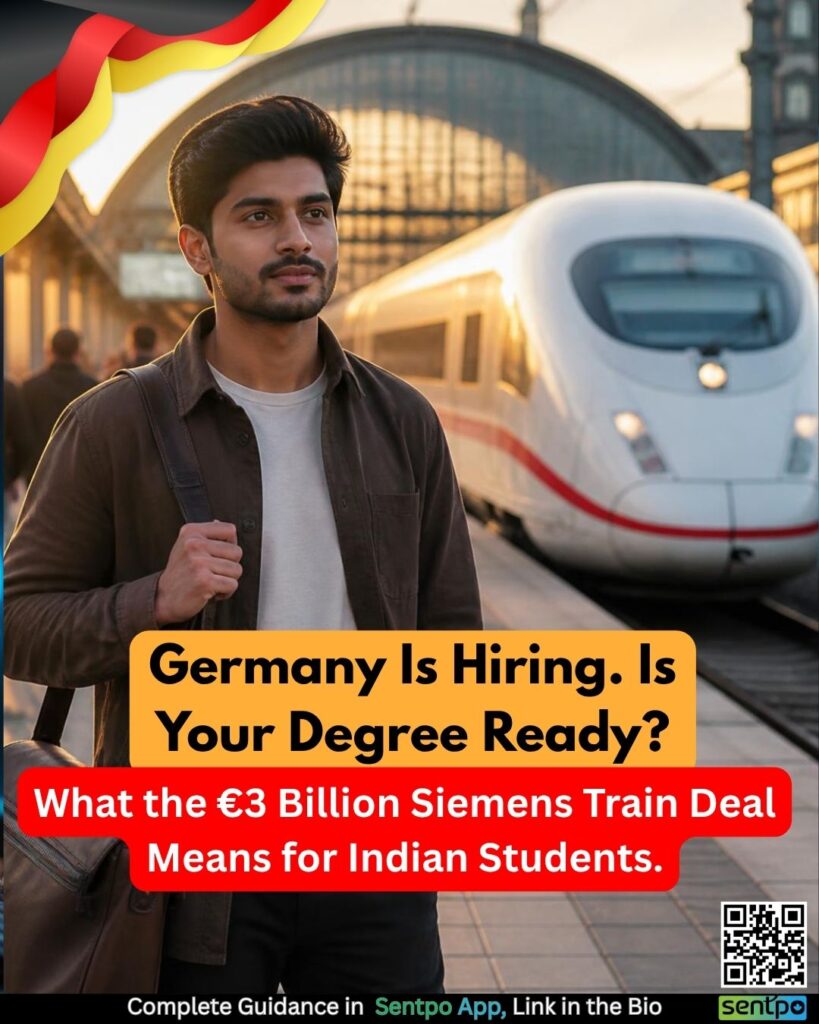
Germany just received one of the largest rail industry investments in recent European history. Italian high-speed operator Italo has signed a €3 billion contract with Siemens Mobility for 26 next-generation Velaro high-speed trains — manufactured in Germany, maintained in Germany, and operated in Germany from 2028. For Indian students planning a Master’s degree and a career in Germany, this is not just news. It is a career roadmap.
✈️ Planning your career in Germany? Sentpo connects Indian students with verified education consultants who can guide you to the right German university and programme. Download the Sentpo app — link in bio.
What Happened — The Deal Explained Simply
In July 2026, Italy’s private high-speed rail operator Italo Holding signed a landmark contract with Siemens Mobility — Germany’s leading rail technology company — for the supply of 26 Velaro Multi System high-speed trains, with an option for an additional 14 units. The contract is valued at approximately €3 billion and includes a comprehensive 30-year maintenance agreement.
The trains will be manufactured at Siemens Mobility’s facility in Krefeld, Germany, and long-term maintenance will be carried out at Siemens Mobility’s depot in Dortmund, Germany. Italo plans to launch operations in Germany from mid-2028, running 50 daily services connecting 18 cities across two major corridors — Munich–Cologne–Dortmund and Munich–Berlin–Hamburg.
Each train will carry approximately 440 passengers, reach speeds of up to 320 km/h, and operate across four different power supply systems — making them among the most technically advanced trains in Europe.
📊 The total investment by Italo in Germany, including fleet, stations, IT infrastructure, and recruitment, amounts to €3.6 billion — one of the single largest private rail investments in German history. Source: Siemens Mobility Press Release · Railway Pro
Why This Deal Creates Jobs in Germany
This is not a deal where the money leaves Germany. The manufacturing happens in Krefeld. The maintenance hub is in Dortmund. The operations base is across Germany. Every aspect of this contract — from building trains to running them to maintaining them for 30 years — requires skilled people working in Germany.
Italo’s entry into the German market will require the recruitment and training of approximately 2,500 employees, including both direct and indirect jobs — covering train operations, station management, IT infrastructure, customer service, and corporate functions. This comes on top of the hiring Siemens Mobility itself will do to fulfil the manufacturing and 30-year maintenance contract.
Beyond this single deal, Siemens Mobility reported revenue of €12.4 billion in fiscal year 2025 and employs approximately 43,400 people worldwide — making it one of the largest employers of engineering and technology professionals globally. A contract of this scale at their German facilities means sustained, long-term hiring well into the 2030s.
💡 For Indian students graduating from German universities in 2027 and 2028, the timing could not be better. Germany’s 18-month post-study work visa gives you exactly the runway you need to land one of these roles.
Which Fields Will See the Most Hiring
Based on what this contract involves — train manufacturing, digital monitoring, multi-system electrification, 30-year maintenance, and new rail operations — here are the specific fields where jobs in Germany will grow directly as a result of this deal:
Field 1
Mechanical & Rail Engineering
The Krefeld facility will manufacture 26 to 40 Velaro trains. This requires mechanical engineers, production engineers, rail systems engineers, and quality control specialists across the full production lifecycle.
Key roles: Mechanical Engineer, Production Engineer, Rail Systems Engineer, Quality Assurance Engineer
Field 2
Electrical Engineering & Power Systems
The Velaro Multi System trains are designed to operate under four different electrification systems — 1.5 kV and 3 kV direct current, and 15 kV and 25 kV alternating current. Engineering teams must design, test, and maintain these multi-voltage systems, creating demand for power electronics and electrical engineering specialists.
Key roles: Electrical Engineer, Power Systems Engineer, Embedded Systems Engineer, Traction Systems Specialist
Field 3
Software Engineering, AI & Data Science
The maintenance contract will use the Railigent X digital platform — Siemens Mobility’s AI-powered fleet monitoring system — to collect and analyse technical data from the trains and enable predictive maintenance. This is a growing area of Siemens Mobility’s business and requires a large team of software developers, data scientists, and AI engineers.
Key roles: Software Engineer, AI/ML Engineer, Data Scientist, IoT Engineer, Platform Engineer
Field 4
Maintenance Engineering & Reliability
The 30-year maintenance contract, based at Siemens Mobility’s Dortmund depot, is one of the largest long-term service agreements in European rail. It will require a dedicated team of maintenance engineers, reliability engineers, and depot managers for three decades.
Key roles: Maintenance Engineer, Reliability Engineer, Depot Manager, Technical Operations Manager
Field 5
IT Infrastructure, Connectivity & Cybersecurity
The Velaro trains will be equipped with ultra-fast 5G and Starlink satellite connectivity for passengers and operational telemetry. Managing this connectivity infrastructure across a fleet operating across multiple countries requires significant IT and network engineering expertise.
Key roles: Network Engineer, IT Infrastructure Specialist, Cybersecurity Analyst, Connectivity Systems Engineer
Field 6
Project Management, Logistics & Operations
A contract of this scale — manufacturing in Krefeld, maintenance in Dortmund, operations across 18 German cities — requires hundreds of project managers, supply chain specialists, procurement officers, and operations managers to keep everything running.
Key roles: Project Manager, Supply Chain Manager, Procurement Specialist, Operations Manager, Logistics Coordinator
Which Master’s Programmes Should Indian Students Study?
Based directly on the skills this deal demands, here are the most relevant Master’s programmes to study at German public universities — all at zero or near-zero tuition for international students:
For Manufacturing & Rail Engineering
| Programme | University |
|---|---|
| MSc Mechanical Engineering | RWTH Aachen, TU Munich, TU Berlin |
| MSc Rail Systems Engineering | TU Berlin, TU Dresden |
| MSc Production Engineering | RWTH Aachen, Hamburg University of Technology |
For AI, Software & Data Science
| Programme | University |
|---|---|
| MSc Computer Science / AI | TU Munich, University of Stuttgart |
| MSc Data Science | Georg-August-Universität Göttingen, TU Berlin |
| MSc Informatics | TU Munich, KIT Karlsruhe |
For Electrical & Power Systems Engineering
| Programme | University |
|---|---|
| MSc Electrical Engineering & IT | TU Munich, RWTH Aachen |
| MSc Power Engineering | KIT Karlsruhe, TU Dresden |
| MSc Embedded Systems | TU Munich, University of Stuttgart |
For Project Management & Operations
| Programme | University |
|---|---|
| MSc Industrial Engineering & Management | TU Berlin, RWTH Aachen |
| MSc Supply Chain Management | Frankfurt School, EBS University |
How Germany’s Post-Study Work Visa Helps You
Germany offers one of the most generous post-study pathways in Europe. After completing your Master’s degree, you are eligible for an 18-month job seeker visa, which allows you to stay in Germany and search for employment without needing a sponsor.
Once you secure a job with a salary above €45,300 per year — which engineering and technology roles at companies like Siemens routinely offer — you can apply for the EU Blue Card, one of the most powerful long-term residence permits in Europe. After 21 months on the Blue Card, you can apply for permanent residence.
✅ Indian students who begin a Master’s in Germany in 2025 or 2026 will graduate right as Italo launches operations in 2028 and Siemens Mobility ramps up its Krefeld production. The timing is as good as it gets.
The Bigger Picture — Why Germany Is the Right Choice Right Now
The Italo–Siemens deal is one signal in a much larger trend. Germany is actively expanding its rail network, transitioning its energy infrastructure, and investing heavily in AI and digital technology. All three areas are creating sustained demand for the kinds of engineers, software developers, and managers that Indian universities produce every year.
India is already the number one source country for international students in Germany, with 49,483 Indian students enrolled in the 2024–25 academic year. The German government has also made it easier than ever for Indian graduates to stay and work — the job seeker visa, the EU Blue Card, and the recognition of Indian engineering qualifications all support this pathway.
And with tuition at most German public universities at €0 for international students, the investment required to access this opportunity is a fraction of what studying in the UK, USA, or Australia would cost.
At a Glance — Key Facts from This Deal
| Detail | Information |
|---|---|
| Contract value | €3 billion (~₹27,000 crore) |
| Total Italo investment in Germany | €3.6 billion |
| Trains ordered | 26 (option for 14 more) |
| Manufacturing location | Krefeld, Germany |
| Maintenance location | Dortmund, Germany (30 years) |
| Jobs created | ~2,500 (direct + indirect) |
| Operations launch | Mid-2028 |
| Cities connected | 18 cities, 2 corridors |
| Train speed | Up to 320 km/h |
| Digital platform | Railigent X (AI-powered) |
| Siemens Mobility employees | ~43,400 worldwide (FY2025) |
Your Next Steps as an Indian Student
If you are an Engineering, Computer Science, or Business graduate looking to build a career in Germany, here is what you should do right now:
01 | Choose the right programme. Use the tables above to identify which Master’s programme aligns with the roles being created. Engineering, AI, data science, and project management are all in demand. |
02 | Check if you need the dMAT. From 2026, Engineering, Commerce, and Business graduates applying to German Master’s programmes must take the dMAT test as part of the APS process. Registration opens 29 June 2026. |
03 | Start your language preparation. Most Bachelor’s programmes in Germany require German C1. English-taught Master’s programmes require IELTS 6.5 or TOEFL 90. Start now. |
04 | Shortlist your universities. Apply via uni-assist.de for most programmes. Apply early — deadlines for Winter 2026 semester are typically 15 July 2026. |
05 | Connect with a verified consultant on Sentpo. A verified consultant can guide you from programme selection and APS documentation through to your visa and blocked account setup — fully digitally, with no office visits required. |
✈️ Start Your Germany Journey
Find your German Master’s programme on Sentpo and connect with a verified consultant today.
Browse verified programmes, shortlist your options, manage your full application, and process your student visa — all through the Sentpo app. No office visits. Fully digital.
→ Download the Sentpo AppSources
▪ Siemens Mobility — Official Press Release: Italo Orders Velaro High-Speed Trains from Siemens
▪ Siemens Mobility — Siemens Mobility Global Homepage
▪ Railway Pro — Italo Orders 26 Velaro Trains from Siemens
▪ Rail Advent — Siemens Agrees Deal for High Speed Trains Worth €3 Billion
▪ Trip by Trip — Italo Confirms €3.6 Billion Investment in Germany
Related Posts
NVIDIA Germany Investment: Best Courses for AI Jobs
Germany Careers | Artificial Intelligence | Study Pathways NVIDIA and Germany’s AI Investment: Best Study Programmes to Prepare for Future…
Want to Work in Germany? Courses for Amazon Career Opportunities
Germany Careers • Study Pathways • International Jobs Want to Work in Germany? Study Programmes to Explore as Amazon Expands…