
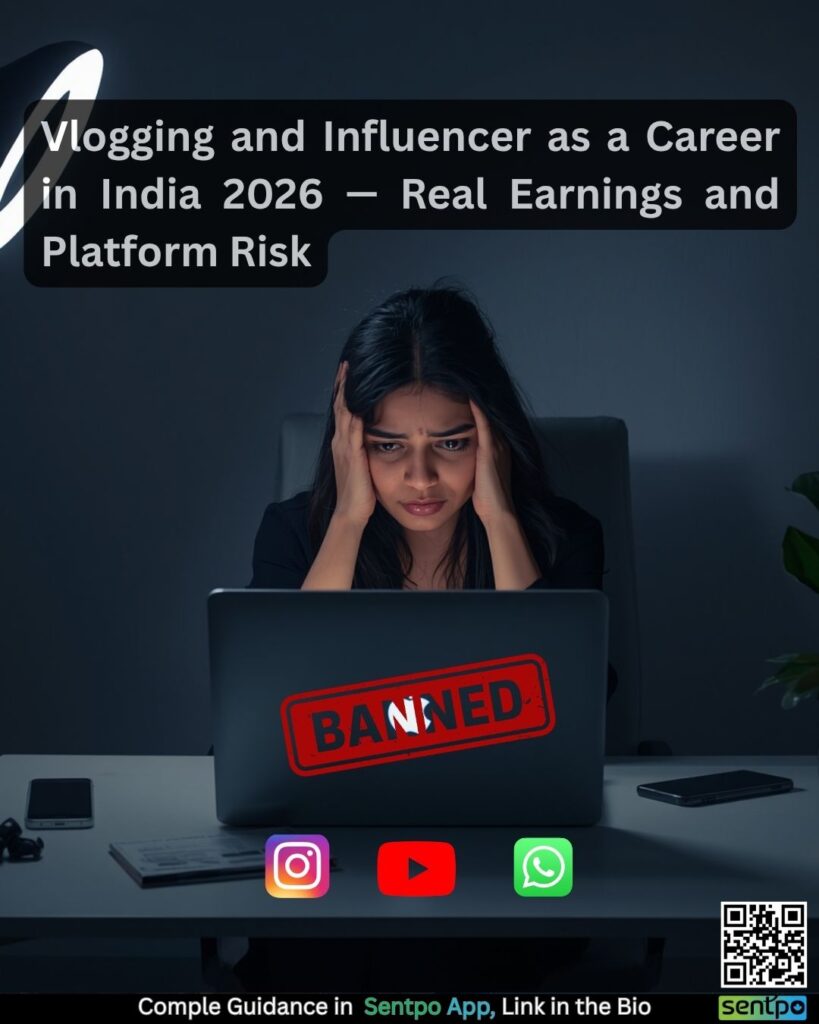
Vlogging and Influencer as a Career in India 2026 — The Real Story Nobody Tells You
Career Guide • Creator Economy • India 2026 • YouTube • Instagram • Platform Risk
Vlogging and Influencer as a Career in India 2026 — The Real Story Nobody Tells You
Is vlogging and being an influencer a good career choice in India in 2026? The honest answer is: yes — for the very few who understand exactly what the game is. And no — for the majority who are chasing a dream they have seen on a screen without understanding the brutal math behind it. This article does not sugarcoat. It gives you the real earnings, the real odds, the new IT rules, the platform ban risk, what happened when TikTok was banned overnight in India, what Indian creators actually earn at different stages, and — most importantly — whether you should build a career that depends entirely on platforms owned by foreign companies who can disappear from your country tomorrow morning.
Sentpo Career Team • Updated May 2026 • Sources: YouTube India, EY India Creator Report, Decoding Influence Annual Report 2026, Reuters, CoherentMI Market Research, New IT Rules 2026, upGrad, Goldman Sachs Creator Economy Report
The size of the opportunity: India’s creator economy is currently worth ₹3,000–3,500 crore and growing at 22% CAGR. YouTube contributed USD 1.8 billion to India’s GDP in 2024 and generated 9,30,000 jobs. India has 4–4.4 million active content creators. The influencer marketing market will reach ₹5,000 crore by 2027. This is real money. But most of it is concentrated in a very small number of creators at the top.
In This Guide
- The Real Numbers — What Indian Creators Actually Earn
- The Creator Economy in India — How Big Is It Really
- The Path Nobody Shows You — What It Actually Takes
- The Platform Ban Risk — What If YouTube or Instagram Gets Banned?
- What Happened When TikTok Was Banned — The India Story
- New IT Rules 2026 — What Every Indian Creator Must Know
- The Best Niches for Indian Creators in 2026
- How to Build a Platform-Proof Creator Career
- Should You Pursue This as Your Main Career?
- Frequently Asked Questions
The Real Numbers — What Indian Creators Actually Earn
Let us start with the number that matters most — and the one that is almost never shown on YouTube thumbnail cards promising “₹1 crore from YouTube.”
AdSense alone pays Indian creators between ₹50 and ₹200 per 1,000 views. That means 1 million views earns between ₹50,000 and ₹2,00,000 from ads — and that is before YouTube’s 45% cut. Your actual take-home from 1 million views in India: ₹27,500 to ₹1,10,000. Now think about how long it takes to make a video that reaches 1 million views.
Indian Creator Earnings — Annual Estimates Across All Revenue Streams
Hobby channel (5K–50K subs, 5K–50K monthly views)
₹0 to ₹2 lakh/year • Most quit before reaching this stage
Growing channel (50K–200K subs, 50K–500K monthly views)
₹2 to ₹12 lakh/year • Sponsorships begin entering the picture
Mid-size channel (200K–1M subs, 0.5–3M monthly views)
₹12 to ₹60 lakh/year • Serious income but requires 3–5 years to reach
Top tier (1M–5M subs, 3–20M+ monthly views)
₹60 lakh to several crores/year • Less than 1% of creators ever reach this
Top Indian creators (Technical Guruji, CarryMinati, etc.)
₹5 crore to ₹70 crore+/year • These are outliers — not benchmarks
Brand sponsorships are where the serious money actually comes from — not AdSense. Nano influencers (1K–10K followers) charge ₹1,000–₹5,000 per sponsored post. Micro influencers (50K–200K subs) earn ₹20,000–₹1.5 lakh per sponsored video. Mid-tier creators (200K–1M subs) earn ₹1.5 lakh–₹6 lakh per sponsored video. Top creators (1M+ subs) earn ₹6 lakh–₹50 lakh+ per sponsored video. The majority of successful Indian YouTubers earn only 30 to 40% of their total income through AdSense — the rest comes from brand deals, affiliate marketing, merchandise, courses, and memberships.
The number nobody talks about: India has 4–4.4 million active content creators. YouTube has a Partner Program that requires 1,000 subscribers and 4,000 hours of watch time before you can earn a single rupee from ads. The vast majority of India’s 4 million creators never reach monetisation. Of those who do, only a small fraction earn enough to replace a salary. The creator economy is enormously large but the income is concentrated at the top — like most creative industries.
The Creator Economy in India — How Big Is It Really
Despite the brutal math at the bottom, the Indian creator economy at the top is genuinely one of the most exciting economic developments in the country. Here are the verified numbers:
The Market Size
India’s influencer marketing industry is currently valued at ₹3,000–3,500 crore in 2025 and is projected to expand to ₹4,500–5,000 crore by 2027 sustaining a 22% CAGR. The influencer marketing market in India is valued at $3.5 billion in 2026, growing at 25% year-over-year. EY India pegs the sector at ₹3,375 crore by 2026. By any measure, this is one of the fastest-growing segments of India’s entire economy.
YouTube’s Footprint in India
YouTube contributed USD 1.8 billion to India’s GDP in 2024 and generated 9,30,000 jobs in its creative ecosystem. India is YouTube’s largest market globally with over 467 million active users. YouTube plans to invest USD 100 million for fiscal years 2025 and 2026 to accelerate the growth of Indian creators, media partners, and artists. Over 1 million Indian creators monetized content via Instagram Reels bonuses and brand partnerships in 2024.
Creator Economy Growth Forecast
India’s creator economy market is expected to reach USD 3,926.2 million (₹32,000+ crore) by 2030, from USD 976 million in 2023 — a CAGR of 22% through the decade. Around 17 to 20% of India’s $2 trillion consumption expenditure is already influenced by creators on social media. The $350–400 billion consumer spending pie influenced by creators is expected to grow to over $1 trillion by 2030.
The Creator Landscape in 2026
India has 4–4.4 million active content creators. Instagram is the primary platform for 3.3–3.7 million of them. Independent individual creators dominate, holding 56.6% of the market in 2026. 92% of influencers prefer short-form videos with YouTube Shorts and Instagram Reels dominating. The top content niches driving growth are lifestyle (39%), fashion (26%), and beauty (15%). Gaming, education, finance, and tech are growing fastest in terms of CPM and brand deal value. Regional language content is identified as the single biggest untapped growth area in India’s creator economy.
The Path Nobody Shows You — What It Actually Takes
Every successful Indian creator you follow has one thing in common with every unsuccessful one who quit: they both started the same way. The difference is almost never talent. It is almost always a combination of consistency, niche clarity, and understanding that this is a business — not a hobby that happens to earn money.
Year 0 to Year 1 — The Invisible Stage
Most creators earn ₹0 in their first year. YouTube requires 1,000 subscribers and 4,000 watch hours before you can even apply for the Partner Program. Getting there takes most creators 6 to 18 months of consistent posting — sometimes longer. During this entire period you are creating content, editing videos, managing social media, writing scripts, learning SEO — all without a single rupee coming back. Most people quit here. The ones who do not are the ones you eventually watch.
Year 1 to Year 3 — The Grinding Stage
After reaching monetisation, most creators earn ₹2,000 to ₹20,000 per month from AdSense alone. Small brand deals begin appearing — often for products you would not normally use. This stage is the most financially stressful because you are creating content full-time but earning part-time wages. Creators who survive this stage do so because they either have another income source (job, family support) or they have pivoted to a high-CPM niche and are growing fast enough to attract meaningful sponsorships.
Year 3 to Year 5 — The Inflection Stage
This is where the income starts to feel real. Brand sponsorships become predictable. Affiliate income compounds. Some creators launch courses, books, or merchandise. The audience has trust, and trust converts to purchase. This is the stage most people see when they see a successful creator — but they do not see the 3 to 5 years of invisible work that preceded it. Ranveer Allahbadia (BeerBiceps) ran his channel for years before breaking through. CarryMinati started at age 10 and spent years before hitting viral scale.
What Nobody Tells You About the Algorithm
The algorithm does not care about quality. It cares about retention, click-through rate, and watch time. A great video that nobody clicks on dies. A mediocre video with a compelling thumbnail and title can reach millions. Understanding this is the difference between a creator who grows and one who makes beautiful content that nobody watches. Creator growth is 70% distribution strategy and 30% content quality — not the reverse, as most beginners assume.
The Platform Ban Risk — What If YouTube or Instagram Gets Banned in India?
This is the question every Indian creator thinks about but most avoid answering directly. Let us answer it clearly.
Is YouTube getting banned in India? No — not right now. A viral claim that YouTube would be banned in India on March 1, 2026 spread rapidly across creator communities and WhatsApp groups. It was false. What actually happened was that the Government of India tightened digital platform regulations requiring platforms including YouTube to act faster on unlawful or harmful content. This was misread as a ban. YouTube is not banned and continues to operate normally.
Is Instagram getting banned in India? No. Instagram is not banned in India and continues to function normally. Both Meta and the Indian government debunked ban rumours in May 2025. Certain social media accounts linked to Pakistan were blocked — this was misinterpreted as a precursor to a full platform ban, which it was not. Meta stated clearly: “We are committed to complying with Indian regulations and policies, and Instagram continues to operate smoothly in the country.”
But could it happen? Yes. TikTok was banned overnight in India. That was real. And it happened fast — no warning, no grace period, no way to export followers. India, Karnataka state specifically, has proposed blocking under-16s from social media. Indonesia has announced similar measures. The global trend toward social media regulation — not necessarily bans but more likely age restrictions, content mandates, and compliance requirements — is real and accelerating.
The real risk for Indian creators in 2026 is not a sudden YouTube ban — it is a gradual regulatory environment that increases compliance costs, restricts content types, and reduces safe-harbour protections for smaller creators. The New IT Rules 2026 have already done this. More is likely coming.
What Happened When TikTok Was Banned — The India Story Every Creator Must Know
India banned TikTok and nearly 60 other Chinese apps in June 2020. The ban erased the app from the lives of 200 million Indian users overnight. No warning. No grace period. Accounts, followers, content, income — all gone. This is the most important case study for any Indian creator building a career on a foreign platform.
What Happened to Indian TikTok Creators
Gaurav Arora, who had 10.8 million followers on TikTok and was earning ₹1,00,000 to ₹2,00,000 per month, had to act immediately. He shifted to YouTube and Instagram and now has 11.3 million YouTube subscribers — but he was one of the lucky ones. Most creators with millions of TikTok followers could not replicate their audiences on new platforms. Follower counts do not transfer. Brand relationships do not transfer. The audience’s habit of finding you on a specific app does not transfer. You start from zero — or close to it — on every new platform.
Who Benefited From the TikTok Ban
The clear winner of India’s TikTok ban was Instagram. Instagram Reels — a TikTok-like feature launched in August 2020, just months after the ban — found its biggest audience in India. Indian short-form platforms like Moj were also able to capitalise quickly. ByteDance completely pulled out of India. The people of India lost the ability to engage with content from creators they followed for years. For brands and the Indian influencer marketing industry — there was disruption, but new winners emerged quickly. For small creators — many simply stopped creating entirely.
The lesson from the TikTok ban: No platform is permanent. The relationship between the Indian government and foreign tech platforms can change overnight based on geopolitical events, national security decisions, or regulatory non-compliance. Building your entire career on one foreign platform is as risky as building your entire business in a rented shop where the landlord can change the locks without notice. The solution is not to avoid these platforms — it is to own what is portable. Your email list is portable. Your domain is portable. Your personal brand is portable. Your platform following is not.
New IT Rules 2026 — What Every Indian Creator Must Know
The New IT Rules 2026 represent the most significant legal disruption to India’s creator economy since the original IT Act was passed. Safe-harbour protections — the legal shield that protects platforms and creators from liability for user-generated content — are now conditional. Penalties are severe. The compliance window is already open.
Safe Harbour Is No Longer Automatic
Previously, platforms like YouTube and Instagram could claim safe harbour — meaning they were not responsible for what users posted. Under the new rules, platforms must act faster on unlawful content and demonstrate compliance with Indian government directives. For creators, this means your content is subject to faster takedown, more aggressive demonetisation, and account suspension — not just by the platform’s own policies but by government-mandated compliance requirements. A solo YouTuber in any Indian city is now operating in the same legal environment as a media company.
Tax Compliance for Creators
NRI and foreign creators monetising Indian audiences face DTAA implications, TDS obligations, and Permanent Establishment risk. Indian creators earning through foreign platform payments — YouTube AdSense from Google USA, Meta brand partnerships — must declare foreign income. The Income Tax Department has increasingly scrutinised creator income, particularly large YouTubers and Instagram influencers who underreport sponsorship income. Brand deals paid in cash or kind (free products, trips, experiences) are taxable income — a fact many creators do not know until an IT notice arrives.
Never Ignore a Government or Platform Notice
Even a routine compliance inquiry left unresponded can escalate into account suspension or an FIR. For creators who have built their income entirely on platform monetisation, an account suspension without recourse is effectively a sudden job loss. Always respond to any government or platform notice within 24 hours. If you are earning above ₹20 to 25 lakhs per year from content creation — get a CA. This is no longer optional.
The Best Niches for Indian Creators in 2026
Not all niches pay equally. The CPM (cost per thousand views) in finance content can be 5 to 10 times the CPM in entertainment content. Choose your niche based on three factors — your genuine interest, the audience size, and the CPM or brand deal potential of that niche.
Personal Finance and Investing — Highest CPM in India. Zerodha, Groww, Angel One, CRED, and every fintech brand pays top rates for audience access. Credibility matters enormously — misinformation in this niche can lead to SEBI notices.
Education and Career Guidance — Massive and underserved audience in India. 100 million students making major decisions with very little information. Trust-based, long-term audience. EdTech brands pay well. This is the niche closest to what Sentpo operates in.
Technology and AI — Growing fastest in terms of both audience and CPM. Indian tech audience is sophisticated and brand-loyal. boAt, OnePlus, Samsung India, and tech companies spend heavily on sponsorships. AI content is the single fastest-growing sub-niche in tech globally.
Regional Language Content — The biggest growth opportunity in India’s creator economy. Hindi content is already crowded. Tamil, Telugu, Kannada, Malayalam, Bengali, Marathi — massive audiences with dramatically lower competition and growing brand interest. Automobile, FMCG, and e-commerce brands are increasing regional language spending fastest.
Long-Form Podcasting — Ranveer Allahbadia (BeerBiceps / The Ranveer Show) demonstrated what long-form interview podcasting can do in India. His estimated net worth is ₹60 to 70 crore. Long-form builds deeper audience relationships, higher brand deal rates per episode, and is harder for casual creators to replicate — meaning less competition at the top.
Gaming — India’s gaming market is expanding rapidly. Gaming channels earn ₹300 to ₹600 per 1,000 views — higher than lifestyle and entertainment. Brands targeting Gen Z gamers pay competitive rates. The audience is young, loyal, and highly engaged.
How to Build a Platform-Proof Creator Career
The TikTok ban taught India’s creators the most important lesson available: never let a foreign platform be your only home. Here is how to build a career that survives platform disruption:
1. Own Your Audience — Build an Email List
Your YouTube subscribers do not belong to you. If YouTube bans your channel tomorrow — or if YouTube itself is banned — your audience is gone. An email list is yours. Nobody can ban your email list. Nobody can change the algorithm for it. Convert your platform followers into email subscribers at every opportunity. Even 10,000 email subscribers who chose to hear from you are worth more than 500,000 passive YouTube followers.
2. Build on Multiple Platforms Simultaneously
YouTube + Instagram + a podcast + a website. If one platform goes down, you are not starting from zero — you already have presence elsewhere. Indian homegrown platforms like Josh, Moj, and ShareChat are growing and deserve attention — not as replacements for YouTube or Instagram but as additional distribution channels where you can build parallel audiences.
3. Diversify Revenue Streams Beyond AdSense
The most resilient Indian creators earn from AdSense, brand sponsorships, affiliate marketing, digital courses, merchandise, live events, memberships, and consulting. No single stream accounts for more than 30 to 40% of their total income. When one stream dips — as it inevitably does — the others continue. Creators who depend entirely on AdSense are the most financially vulnerable to platform changes, algorithm shifts, and demonetisation.
4. Build a Personal Brand — Not a Channel Brand
CarryMinati is a person. Bhuvan Bam is a person. Ranveer Allahbadia is a person. Technical Guruji is a person. Your personal brand travels with you across platforms. A channel brand does not. If your entire identity is tied to a channel name that exists only on YouTube — you have nothing portable. Build your name, your face, your voice, your distinct perspective as the brand. The platform is just distribution.
5. Watch Indian Homegrown Alternatives
Josh, Moj, ShareChat, Chingari, and Koo have all received significant government support and VC funding since the 2020 Chinese app ban. None have yet achieved the scale of YouTube or Instagram in India — but the Indian government has a structural interest in building domestic alternatives. The creator who has an established presence on Indian platforms before a hypothetical future foreign platform restriction will be significantly better positioned than one starting from scratch.
Should You Pursue This as Your Main Career? — The Honest Framework
Yes — Pursue It as a Career If All Four of These Are True
✓ You have a clear niche — not “I want to make videos” but “I want to educate Class 12 students about career options in regional languages” or “I want to review tech products in Tamil for tier 2 audiences.” Specificity is survival.
✓ You have another income source for the first 2 to 3 years — a job, savings, a family that supports you, or a freelance skill you can sell while the channel grows. Trying to force financial returns from a channel before it is ready will kill both the channel and your mental health.
✓ You understand this is a business, not a hobby. You are prepared to learn video editing, SEO, thumbnail design, social media strategy, tax filing, contract negotiation, and email marketing. A successful creator in 2026 is a one-person media company.
✓ You have a portfolio diversification plan from Day 1 — multiple platforms, email list, website, and at least two revenue streams that do not depend on a single platform’s algorithm or ad rate.
Be Very Careful — If Any of These Describe Your Situation
✗ You are planning to quit your job or drop out of college to go full-time on content before you have 200K+ subscribers and consistent monthly income of ₹2+ lakhs. The overwhelming majority of people who do this fail — not because they lack talent, but because they underestimate the time horizon.
✗ You are choosing content creation because you do not want a “boring job” — not because you have something genuinely worth saying. The market is brutally efficient. Audiences do not have to watch you. Give them a reason.
✗ You have not verified that your niche has audience demand and monetisation potential before starting. Creating content for an audience that does not actively search for it is one of the most common and most avoidable mistakes.
✗ Your entire plan depends on one platform — specifically a foreign-owned one — without any contingency for what you do if that platform changes its algorithm, demonetises your niche, or is regulated out of India.
More Career Guides on Sentpo
Download the Sentpo App — Career Guidance, Scholarships and Opportunities
More career guides, job opportunities, study options in India and abroad — all on the Sentpo app. Free on Android and iOS.
Download Sentpo — Android Download Sentpo — iPhone
Do it yourself. Do it right.
Frequently Asked Questions
Is vlogging a good career in India in 2026?
Vlogging can be a good career in India in 2026 — but only for creators who treat it as a business, not a hobby. India’s creator economy is worth ₹3,000–3,500 crore and growing at 22% CAGR. YouTube contributed USD 1.8 billion to India’s GDP and 9.3 lakh jobs in 2024. However, meaningful income takes 3 to 5 years to build, requires multiple revenue streams beyond AdSense, and should be built across multiple platforms to protect against ban or algorithm risks. For creators in high-CPM niches like finance, technology, and education — with a clear niche and consistent strategy — vlogging is a genuinely viable career.
How much do Indian YouTubers earn in 2026?
Indian YouTubers earn between ₹50 and ₹200 per 1,000 views from AdSense in 2026 depending on niche. Finance and tech channels earn toward the higher end. Entertainment and lifestyle channels earn toward the lower end. From all revenue streams combined: hobby channels (5K–50K subs) earn ₹0–2 lakh/year, growing channels (50K–200K subs) earn ₹2–12 lakh/year, mid-size channels (200K–1M subs) earn ₹12–60 lakh/year, and top-tier channels (1M+ subs) earn ₹60 lakh to several crores. Most successful creators earn only 30–40% of total income from AdSense — the rest comes from brand sponsorships, affiliate marketing, courses, and merchandise.
Can YouTube or Instagram get banned in India?
As of May 2026, YouTube and Instagram are not banned in India and there are no credible official plans to ban them. The viral claim of a YouTube ban from March 1, 2026 was false — it was caused by confusion around tighter digital content regulations, not a ban. However, India has previously banned TikTok and 59 other Chinese apps overnight with no warning. The Indian government has also proposed under-16 social media restrictions. No platform can be considered permanently safe — which is why every creator should build their career across multiple platforms and own portable assets like email lists and personal websites.
What happened to Indian TikTok creators after the ban?
When India banned TikTok in June 2020, 200 million users lost access overnight. Top creators like Gaurav Arora (10.8 million TikTok followers) had to immediately shift to YouTube and Instagram and rebuild. He now has 11.3 million YouTube subscribers — but he was among the luckier ones. Most TikTok creators could not replicate their audiences on other platforms because follower counts, brand relationships, and audience habits do not transfer between apps. Instagram Reels emerged as the biggest beneficiary of the ban. Smaller creators largely stopped creating. The lesson: never build your entire creator career on a single foreign platform.
Which is the best niche for YouTube in India in 2026?
The highest-earning niches for Indian YouTubers in 2026 are Personal Finance and Investing (highest CPM, fintech brands pay top rates), Technology and AI (growing fastest, strong brand deals from tech companies), Education and Career Guidance (massive underserved audience, EdTech sponsors), Regional Language Content (biggest growth opportunity — Tamil, Telugu, Kannada, Malayalam content has far lower competition than Hindi), Long-Form Podcasting (builds deeper audience relationships and higher per-episode brand deals), and Gaming (₹300–600 CPM, strong Gen Z brand partnerships). The best niche is one where all three factors align — your genuine interest, strong audience demand, and meaningful monetisation potential.
vlogging influencer career India 2026 • is YouTubing a good career in India • how much do Indian YouTubers earn • YouTube earnings India 2026 • YouTube ban India 2026 • Instagram ban India • TikTok ban India creators • creator economy India 2026 • best niche YouTube India 2026 • influencer career India future • platform ban risk India creators • Sentpo career guide India
Related Posts
NVIDIA Germany Investment: Best Courses for AI Jobs
Germany Careers | Artificial Intelligence | Study Pathways NVIDIA and Germany’s AI Investment: Best Study Programmes to Prepare for Future…
Want to Work in Germany? Courses for Amazon Career Opportunities
Germany Careers • Study Pathways • International Jobs Want to Work in Germany? Study Programmes to Explore as Amazon Expands…