
Germany Labour Market 2026 — What Indian Students and Professionals Must Know Before Choosing a Field
Germany · Labour Market · 2026
Germany’s Labour Market in 2026 — What Every Indian Student and Professional Must Know Before Choosing a Field or Moving
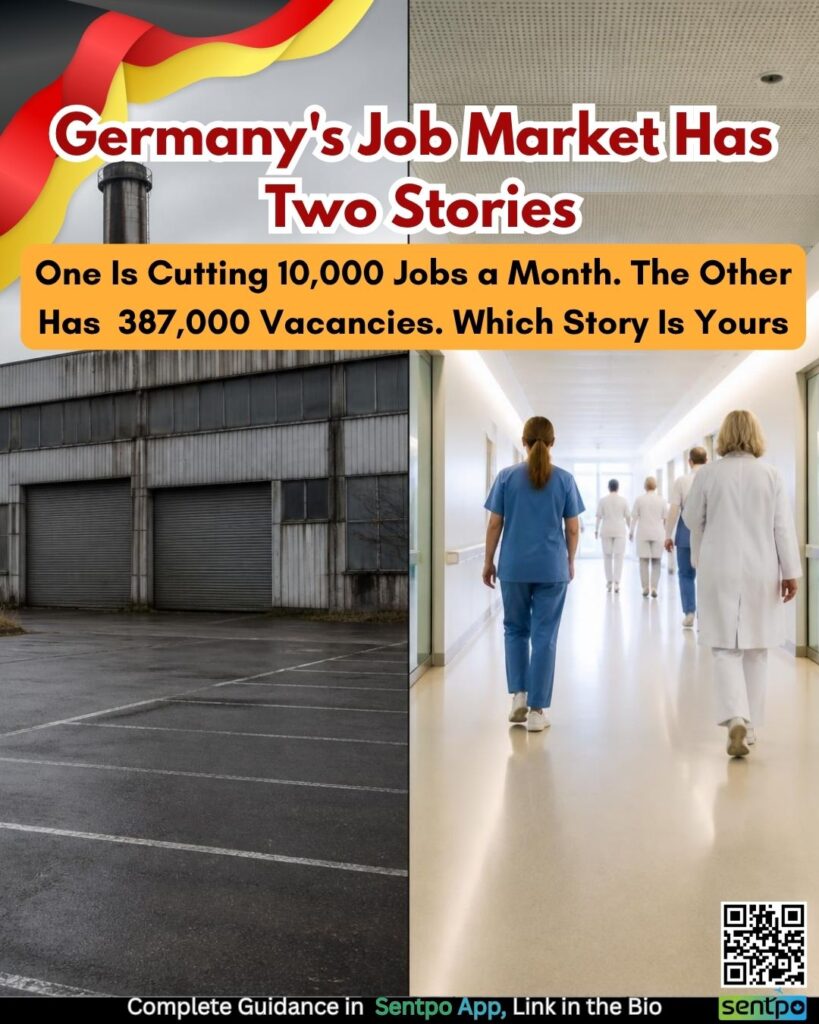
Germany’s labour market in 2026 is not one story — it is two stories happening at the same time. In one story, Germany’s automotive and manufacturing giants are cutting jobs at a rate of 10,000 per month, and unemployment has crossed 3 million for the first time since 2010. In the other story, healthcare, skilled trades, and IT still face a shortage of hundreds of thousands of qualified workers that will take decades to close. For Indian students choosing a field of study and professionals considering a move to Germany, understanding which story applies to you — and why — could be the most important career decision of your decade.
📌 Key 2026 numbers: Unemployment rate 6.6% (January 2026, registered) · ILO rate 4.2% · 3,085,000 unemployed · 163 shortage occupations confirmed by the Federal Employment Agency · 125,000+ industrial jobs cut in 2025 · 149,000 unfilled IT roles · Healthcare shortage: 387,000 vacancies · Automotive employment lowest since 2011
✈️ Planning to study or work in Germany? Sentpo connects Indian students and professionals with verified education and career consultants who know the 2026 German labour market inside out. Download the Sentpo app — link in bio.
The Big Picture — Germany’s Labour Market in 2026
Germany recorded 45.52 million employed persons in March 2026 — down from an all-time peak of 46.09 million in late 2024. The ILO unemployment rate stood at 4.2% in February 2026. Registered unemployment crossed 3 million for the first time since 2010. The Federal Employment Agency’s January 2026 press release confirmed: unemployment increased by 177,000 to 3,085,000, with the registered rate rising to 6.6%.
At the same time — and this is the critical nuance — the Federal Employment Agency still reports 163 occupations facing qualified worker shortages. Healthcare, skilled trades, and technical roles account for a large share of unfilled positions. Care, IT, and skilled trades are the three industries with the most structural shortage — missing not just people, but entire generations of workers. The cost of this shortage is estimated at 49 billion euros in lost value creation per year.
This creates a paradox that is essential to understand: Germany is simultaneously shedding jobs in specific sectors and desperately short of workers in others. The unemployment figure and the shortage figure are both true — they just refer to completely different parts of the economy and completely different skill sets.
📌 The structural paradox: Around 1.14 million skilled workers were unemployed in 2024. Yet hundreds of thousands of jobs still went unfilled. The reason? A clear mismatch. Only about 25% of unemployed workers searched in bottleneck occupations. The problem is not lack of jobs — it is lack of the right skills in the right places.
Why Is This Happening? The Three Forces Reshaping Germany’s Labour Market
Force 1 — Demographic Collapse
The retirement of the baby boomer generation will reduce the number of employees by around 7 million people by 2036, according to the Institute of Economics, if no increased labour force participation within Germany or labour migration to Germany is generated. 13.4 million people in the workforce will retire by 2039, while only 12.5 million will enter. Even with high immigration, the working-age population will shrink by 3.2 million. The Institute for Employment Research (IAB) estimates Germany needs about 300,000 skilled workers per year from abroad just to maintain current staffing levels. This demographic reality is permanent and irreversible — it is the single most important structural fact about the German labour market.
Force 2 — Industrial Restructuring
Since 2019, Germany’s industrial sector has shed around 341,500 positions — equivalent to slightly more than 6% of its workforce. The automotive industry has been hit hardest, losing approximately 125,800 jobs during the same period. This is being driven by three converging forces: high German energy costs making factories less competitive, the global shift to electric vehicles disrupting traditional powertrain manufacturing, and aggressive competition from Chinese manufacturers particularly in EVs. This is a permanent structural shift, not a temporary downturn.
Force 3 — AI and Digital Transition
A dramatic shift from volume hiring to precision hiring of AI-adjacent specialists is underway. AI-driven productivity gains are reducing demand for routine development work while increasing demand for AI system architects. Significant investments are being made in infrastructure, robotics, chip manufacturing, AI applications, and automation processes. Applicants who have skills in these fields have good chances of finding permanent employment. The digital transition is both destroying low-skill routine jobs and creating high-skill specialist roles — simultaneously.
Sectors Most Vulnerable — What Is Getting Worse
These are the fields where job losses are ongoing, competition for remaining positions is intense, and Indian students or professionals should think very carefully before committing to a career path:
⚠️ Sector 1 — Automotive Manufacturing
Germany’s automotive sector now employs some 721,400 people — employment has fallen to its lowest level since mid-2011. The sector dropped 6.3% year-on-year — higher than in any other major industrial sector. The Volkswagen Group alone has eliminated 15,000 jobs with a further 10,000 signed away. Porsche announced 6,000 cuts. Bosch has cut 22,000, ThyssenKrupp 11,000. Auto suppliers are even more severely affected than manufacturers.
Why: Chinese EV competition, US tariffs, high German energy costs, EV transition reducing complexity of powertrains
Indian students — avoid: traditional automotive engineering roles targeting internal combustion engine specialisations or Tier-1 auto supplier supply chain roles without EV/software skills
⚠️ Sector 2 — Traditional Manufacturing and Chemicals
Four in ten German industrial companies plan further layoffs in 2026, with automotive, paper, and textile sectors hit hardest by rising energy costs and Chinese competition. Manufacturing employment fell by 143,000 — down 1.8% — in 2025 alone. Industrial companies in Baden-Württemberg and NRW in particular are cutting production and investment.
Why: Energy price disadvantage vs global competitors, automation reducing headcount, relocation of production outside Germany
Indian students — caution: general mechanical engineering without specialisation in automation, AI, or green energy conversion
⚠️ Sector 3 — Routine IT and Software Outsourcing
AI-driven productivity gains are reducing demand for routine development work. The hiring market has bifurcated sharply between a struggling traditional economy and a growing but selective digital sector. Companies have shifted from volume hiring of standard developers to precision hiring of AI-adjacent specialists. Generic full-stack developers without specialist skills are facing a tighter market in Germany than three years ago.
Why: AI handling routine coding tasks, shift to specialist roles in AI engineering, LLMOps, and cloud architecture
Indian students — pivot: general software engineering must be supplemented with AI/ML, cybersecurity, or cloud specialisation to remain competitive
⚠️ Sector 4 — Office Administration and Back-Office Roles
Surpluses exist in: office and secretariat, advertising and marketing, corporate management and organisation (general), and building services. Financial services have seen dramatic reductions in back-office staffing as AI handles transaction processing, fraud detection, compliance monitoring, and even basic client advisory functions.
Why: AI automation of document processing, data entry, basic financial analysis, and customer service
Indian students — avoid: pure administrative, general management, or back-office finance roles without technical specialisation
⚠️ Sector 5 — Retail and Hospitality (Cyclical Pressure)
Retail and hospitality remain soft in 2026, with demand failing to recover to pre-crisis levels. While specific skilled hospitality roles (hotel management, culinary arts) remain in shortage, entry-level retail and food service are facing both automation pressure and reduced consumer spending.
Why: Consumer spending contraction, cashierless checkout expansion, food delivery disruption
Indian students — caution: entry-level hospitality or retail-focused programmes without specialist qualifications
Sectors That Are Thriving — The Genuine Opportunities in 2026
These are the fields where Germany’s structural shortage is most acute, where demographic pressure will sustain demand for decades, and where Indian students and professionals have the strongest positioning:
✅ Sector 1 — Healthcare and Nursing
Healthcare has 387,000 vacancies with an 86% talent shortage rate. Care, IT, and skilled trades are the three industries missing entire generations of workers. The ageing population means that issues relating to the care of older citizens will become increasingly relevant. Carers are already needed regardless of overall economic development. Healthcare has the highest job vacancy rate of any sector in Germany — 4.4% in 2023 and continuing to rise.
Why it lasts: AI cannot replace licensed human care. Demographics guarantee growing demand for 30+ years. Green List occupation — direct path to German residency.
Best fields: Nursing (Krankenpflege), Elderly Care (Altenpflege), Physiotherapy, Medical Assistance, Pharmacy
Important note: German language B1–B2 is essential for clinical healthcare roles. This is non-negotiable.
✅ Sector 2 — Specialist IT and AI Roles
Germany recorded 149,000 unfilled IT roles in 2024 — with continued shortages in software development, cybersecurity, cloud systems, and embedded engineering. Without policy shifts or international recruitment, this gap is expected to widen through 2026. The key dynamic is a shift from volume hiring to precision hiring of AI-adjacent specialists. AI system architects, MLOps engineers, cybersecurity specialists, and embedded systems engineers are in acute demand.
Why it lasts: Digital transformation of all industries; AI deployment requires human specialists; Germany’s €500B infrastructure investment programme creating massive demand for digital skills
Best fields: AI/ML Engineering, Cybersecurity, Cloud Architecture, Embedded Systems, Data Science, Software Architecture
English often sufficient for tech roles in Berlin, Munich, Hamburg. German language significantly raises salary offers (10–20% premium).
✅ Sector 3 — Skilled Trades and Construction
Around 30.4% of construction firms still reported gaps as of January 2026. In Germany’s skilled trade shortage, even around 45% of open electrical engineering posts had no candidates at all in 2024. The conversion of heating systems in private homes will create numerous job opportunities for heating engineers and air conditioning technicians. The expansion of wind and solar energy creates new positions across Germany. Local public transport also faces considerable staff shortages.
Why it lasts: Physical work cannot be outsourced or automated. Germany’s green transition requires massive skilled trade workforce. All licensed, physical roles are structurally protected.
Best fields: Electrical Engineering (licensed), Mechatronics, Plumbing and Heating, Civil Engineering, Renewable Energy Technology
German language B1–B2 required for most on-site trade roles. Apprenticeship (Ausbildung) pathway is an excellent entry route.
✅ Sector 4 — Green Energy and Environmental Technology
Green conversion is a major project of the current government. The conversion of the energy industry takes the most space — wind, solar, hydropower, and green hydrogen production. Many new job opportunities are being created in this field. Germany’s €500 billion public investment programme is heavily weighted toward green infrastructure. This is a sector in structural growth that will last decades.
Why it lasts: Government policy mandate, EU Green Deal commitment, energy independence goals. Green jobs are protected by law and investment as a strategic national priority.
Best fields: Renewable Energy Engineering, Environmental Science, Agribusiness and Food Science (Lincoln University NZ and German agri-universities lead here), Sustainable Engineering
✅ Sector 5 — Transport and Logistics (Specialist Roles)
Transport and logistics came into 2024 carrying some of the highest shortage rates of any sector. The ifo survey from January 2026 found that about 30.6% of logistics and transport firms still could not find the staff they needed. Specialist logistics management, supply chain analytics, and freight transport planning remain in strong demand across Germany.
Why it lasts: E-commerce growth requires more logistics professionals; railway freight expansion underway; electrification of freight transport creating new specialist roles
Best fields: Supply Chain Management, Logistics Engineering, Transport Planning, Railway Operations Management
✅ Sector 6 — Education and Social Services
Public services, including health, education, and social care, saw an increase of around 181,000 jobs in the first quarter of 2023, marking a 1.5% gain. There are very good employment opportunities in nursery care, childcare workers, and educators — regardless of economic influences. However, this always requires recognition of professional qualifications and a language level of at least B1.
Germany 2026 — Sector Outlook at a Glance
| Sector | 2026 Status | For Indian Students |
|---|---|---|
| Nursing and Healthcare | 🟢 Acute Shortage | Strongly recommend — B1 German required |
| AI / ML / Cybersecurity | 🟢 High Demand | Strongly recommend — specialist skills essential |
| Electrical and Skilled Trades | 🟢 Acute Shortage | Strongly recommend — German B1 required |
| Green Energy and Engineering | 🟢 Growing | Recommend — aligns with German govt priority |
| Civil Engineering | 🟢 Shortage | Recommend — infrastructure investment driving demand |
| Logistics Management | 🟢 Shortage | Recommend — specialist roles only |
| General Software Engineering | 🟡 Mixed | Caution — routine roles declining, specialist roles growing |
| Mechanical Engineering | 🟡 Mixed | Caution — automation focus essential, EV knowledge preferred |
| Automotive (Traditional) | 🔴 Declining | Avoid — major structural job losses ongoing |
| Traditional Manufacturing | 🔴 Declining | Avoid ICE specialisation — pivot to digital/green |
| Office Administration | 🔴 Surplus | Avoid — surplus workers across all regions |
| General Management / MBA | 🔴 Weak | Avoid without technical specialisation — surplus exists |
Where in Germany — The Regional Labour Market Picture
Where you work in Germany matters almost as much as what you work in. Regional employment rates and unemployment rates vary significantly — and so do the opportunities available:
Bavaria (München, Nürnberg, Ingolstadt) — Unemployment among the lowest in Germany (1.9–2.5% in southern districts). Home to BMW, Siemens, MAN, Allianz, and hundreds of Mittelstand companies. Strong in IT, aerospace, mechanical engineering, and healthcare. The best state for most Indian professionals.
Baden-Württemberg (Stuttgart, Heidelberg, Freiburg) — Traditionally Germany’s strongest industrial state. Now facing pressure from automotive restructuring. Unemployment rising in Stuttgart. Excellent for mechatronics, automation, green energy, and biotech. Avoid if targeting automotive supply chain specifically.
Berlin — Unemployment 5.1% — highest of the major cities. But home to Germany’s most vibrant tech and startup ecosystem. Strong for AI, digital, creative tech, and fintech. Higher cost of living but English widely accepted in tech roles. Good for Indian IT professionals.
Hamburg — Unemployment 4.0%. Major logistics, maritime, aerospace (Airbus), media, and IT hub. Strong for supply chain, logistics management, and engineering. One of Germany’s most international cities.
North Rhine-Westphalia (Düsseldorf, Cologne, Dortmund) — Historically industrial (Ruhr area), now transforming. Kreise with high unemployment are found in the Ruhr area, scarred by decades of decline in coal and steel. However, Düsseldorf and Cologne are strong for IT, international business, and healthcare. Target the cities, not the Ruhr region.
Eastern Germany (Brandenburg, Mecklenburg-Vorpommern, Saxony) — Higher unemployment, below-average wages, but lower living costs. Kreise with high unemployment are found in the east, still bearing the structural legacy of reunification. Avoid for an initial career base unless targeting specific niche opportunities (offshore wind in Mecklenburg, chip manufacturing in Dresden).
The Honest Guide for Indian Students and Professionals — What to Do Now
If you are an Indian student choosing a field of study for Germany
✅ Choose a Green List occupation. Healthcare, nursing, civil engineering, electrical engineering, architecture, and agribusiness are all on Germany’s Green List. These fields have structural shortages that demographics will sustain for decades. They also offer the fastest residency pathway after graduation.
✅ Specialise within IT. General computer science is safer than routine development work. AI/ML, cybersecurity, cloud engineering, and embedded systems are where Germany’s 149,000 unfilled IT roles are concentrated — not in generic development.
✅ Learn German. B1 German opens the healthcare sector entirely. B2 increases salary offers across all sectors by 10–20%. German language is not optional for a serious long-term Germany career — it is the single highest-return investment you can make before you arrive.
✅ Target Bavaria or northern Germany. Bavaria has the lowest unemployment and the strongest economy. Hamburg is excellent for logistics and aerospace. Berlin is the tech hub. Avoid the Ruhr area and eastern German states for your initial career base.
If you are an Indian professional already working or planning to use the Opportunity Card
✅ Do not assume 2021–2022 conditions still apply. Germany has shifted from a generalised talent shortage to a precision shortage. The sectors where India’s skills match Germany’s needs are still strong — but the era of easy placement for any IT graduate is over. Target specifically.
✅ Begin your job search before you arrive. Start applying on LinkedIn, Xing, and StepStone from India. Companies that receive a CV from an Indian IT or engineering professional already showing German language skills and relevant specialist experience will prioritise that application.
✅ Use trial jobs aggressively. The Opportunity Card allows 2-week trial jobs with unlimited employers. This is your most powerful tool to convert interest into an offer — especially in a tighter market where employers are cautious about committing to a full hire before seeing your work.
✈️ Plan Your Germany Journey With Expert Guidance
Find the right field, the right city, and the right pathway — with a verified Germany consultant on Sentpo.
Germany’s 2026 labour market rewards those who choose the right field, build the right skills, and arrive with a plan. Sentpo’s verified Germany consultants help Indian students and professionals navigate all of this — from programme selection to Opportunity Card applications to EU Blue Card guidance.
→ Download the Sentpo AppSources — All verified August 2026
▪ Federal Employment Agency (Bundesagentur für Arbeit) — Labour Market in January 2026 — Press Release
▪ EURES (European Employment Services) — Labour Market Information: Germany (December 2024)
▪ German Federal Ministry for Economic Affairs (BMWE) — Economic Situation in Germany — March 2026
▪ OECD Employment Outlook 2026 — Germany — Structural Transformation Reshapes Local Labour Markets
▪ Makerstations — Employment in Germany Statistics 2026 — Workforce and Unemployment Data
▪ Serrari Group — Germany’s Industrial Job Crisis — July 2026
▪ FMC Group — Germany Skilled Worker Shortage Stats 2026
▪ COAI Research — How Exposed Is the German Job Market to AI? — March 2026
▪ DeepResearch Ninja — The IT Job Market in Germany and Munich in 2026 — Comprehensive Analysis
Related Posts
Kerala Overseas Scholarship 2026: ₹10 Lakh for PG & PhD
SCHOLARSHIP UPDATE • KERALA Kerala Overseas Scholarship 2026: ₹10 Lakh Per Year for PG & PhD Abroad Kerala students planning…
Nursing Ausbildung in Germany Through Triple Win: A Guide for Kerala Students
Nursing Ausbildung in Germany Through Triple Win: A Guide for Students from Kerala Germany offers a structured pathway for young…